
Stories from England's Northern Edge - August, 2026 Submissions
Destiny (and a nod to Gary Larsen)
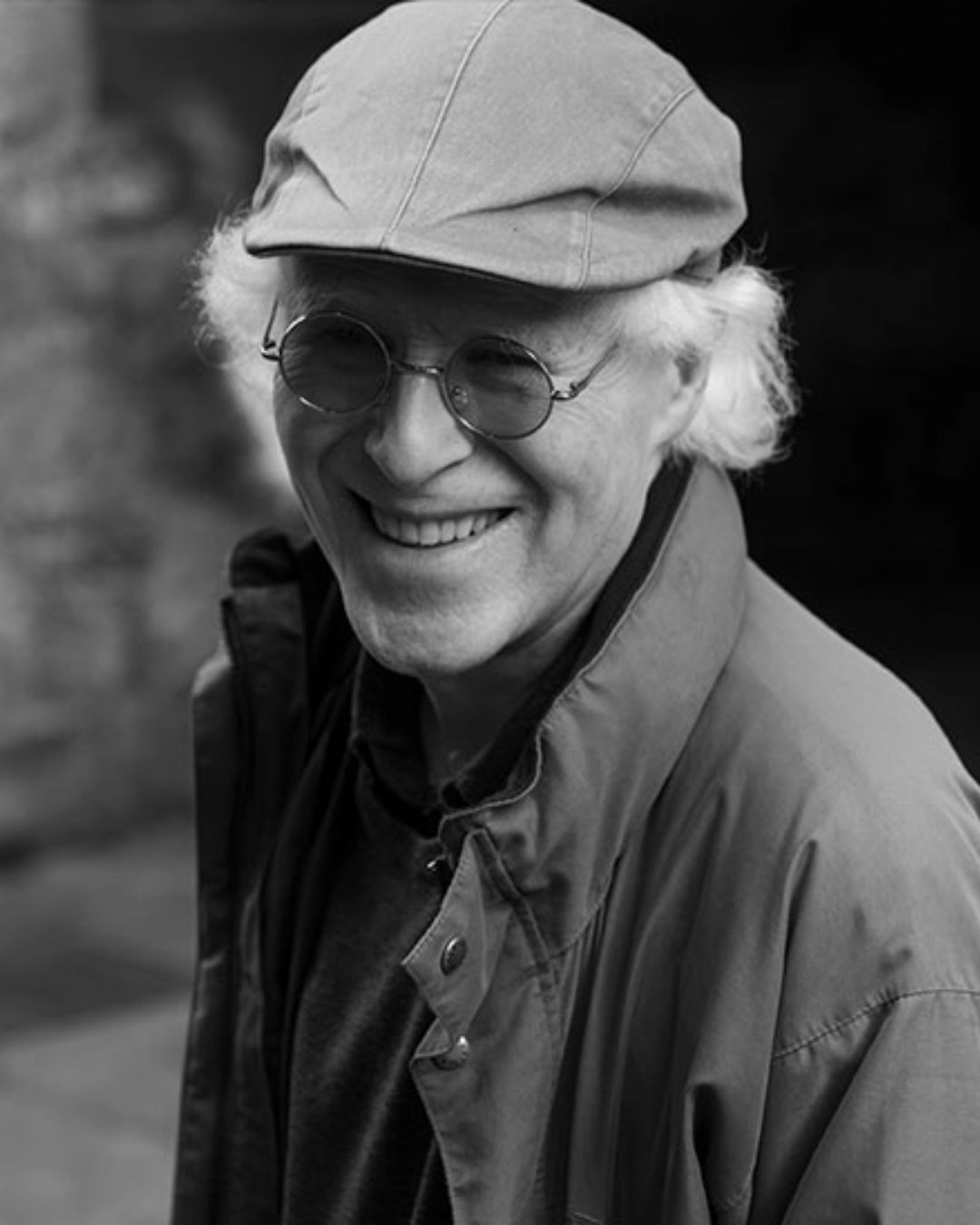
Freeland Barbour
Freeland Barbour is a Scottish musician, composer and writer, and a trustee of Berwick Literary Festival. Originally from Glen Fincastle near Pitlochry, he has been a prominent figure in Scottish traditional music for many years. A former BBC Radio Scotland music producer, Freeland is a prolific performer and composer, with the accordion as his principal instrument.
Freeland says of this lyrical piece, 'Destiny is a light-hearted, personal interpretation of Gary Larson’s cartoon, "Welcome to Heaven, here’s your harp / Welcome to Hell, here’s your accordion." As an accordion player myself, I couldn’t resist taking the idea a little further.'
Destiny
(and a nod to Gary Larsen)
Auld Nick was dirlin’ doon in Hell,
Bent-double on his knees,
And wi’ his bellows in his hand
Was blawin’ up a bleeze.
Just then there came a knockin’ sound
Above the furnace’ roar.
“Aw jings” he muttered tae himsel’
“Wha’s chappin’ at my door?”
So up he got, wi’ creak and groan
And mony a curse and jibe,
And flung back a’ the locks and bolts
And opened the door wide.
A stranger lad stood on the step,
A paper in his fist,
And firmly, wi’ his other hand,
He held a muckle kist.
“Weel weel” cried Nick, “What’s a’ this then,
This rappin’ at my gate?
What’s your will my lad?” says he,
“Come on noo don’t be blate.”
“Thro’ a’ my days” the stranger said
“I’ve traivelled far and wide
And no matter where I ga’ed
This kist was by my side.
Frae Berwick up tae John o’ Groats
And doon the western side,
Frae Aiberdeen tae Dumfries toun,
Frae Moray Firth tae Clyde.
But then my days on earth were done
And up tae Heeven I came
And there behind the Pearly Gates
St. Peter checked my name.
It wasnae on his list at a’,
Which caused him some concern,
Until his gaze fell on my kist
And his brows grew bleak and stern.
“You’ll no’ get in wi’ that” says he
And pointed tae a sign
That hung doon frae the gatepost there,
“Harps only” was the rhyme.
But Peter’s no’ a bad lad
And he aye does what he can.
“There’s no’ a chance in here” says he
“but I hae anither plan.”
“So dinna be despondent, son,
There is anither place.
I ken the lad that runs it
And you’ll maybe get a space.”
“I’ll gi’e directions” Peter said
And tae show jist what he meant
He quickly pu’ed his ipad oot,
Google maps was his intent.
But he couldna mind the postcode
Though he did his best I’m sure.
It’s been a trauchle gettin’ here.
I’m glad tae see your door.”
When Nick had heard this tale he smiled
(An awfie sicht tae tell),
“Ye’re welcome here my lad” says he,
“Come in and warm yersel’.”
“Then later on, when lamps are lit,
And nicht is drawin’ on,
Brak oot your kist, and gi’e’s a tune
On your accordion.”
Shopping in Nigeria - Going to Market
Carolyn Poulter
Carolyn joined the creative writing group Word Weavers based in Duns in 2021. She had only ever written factual reports in her working life so found the shift challenging. She has read some of her pieces at DunsPlayFest, Talking Newspapers, Cabaret of Words in Berwick, and at Community Lunches in Duns. She is currently working on developing a memoir - but when or if it will be finished is another challenge.
Of the following creative non-fiction, Carolyn says, 'This is a recollection of going to the market in Nigeria with my mother once a week. This was a long time ago when I was nine just before I went to Boarding School. It is based on real life events.'
Shopping in Nigeria - Going to Market
My mother went shopping every Wednesday morning. So after breakfast there was a rush to get the list completed, instructions left for those staying at home and bags put into the car.
By the time we set off it was already boiling hot and the flies were nipping. The sun was high in a cloudless sky that was a dazzlingly reflective white.
We drove into the gravel car park guided by some helpful boys, in a cloud of dust, I always thought my mother was not totally in control of the car as she always had to slam on the brakes at the last minute.
Almost immediately a surge of young people surrounded the car. I usually closed the windows to stop all the eager hands being thrust in to try and touch my long white plaits. I was very different from the young Nigerian children.
The excitement, smell, noise and colour of the market assaulted your senses.
The expectation was palpable.
The colourful fabric, the baskets piled high with spices and fruit in every shape, size and colour. There was the rich smell of cooking, the tang of cologne and body odour which with the obstacle course of assorted rubbish and litter underfoot made walking in a straight line impossible. Together with the surge of pushing shoving and pulling crowds all wanting to strike a bargain and pass on their news.
My mother walked determinedly through the crowd forging a path between the stalls. She had her favourite traders and always had to test and feel everything she bought. Shopping was not quick. At the egg man’s stall all the eggs had to be tested in water to see if they floated or not, to check their freshness before any were carefully placed in her bag. After a vigorous haggling session.
But when we went to the meat market I nearly always felt sick. Many of the traders ran towards my mother with lumps of meat in their arms covered in flies. They tried to convince her that their meat was the freshest and while doing so held it towards her above my head. I nearly always ended up with blood dripped onto my hair. If anything was going to make you vegetarian that was it. It was like being in your own horror movie! I hated it.
The upside to the trip was a visit to a store called Chelerarms a department store in Enugu where I was bought an ice cream. Mum bought herself a bar of Toblerone and some Callard and Bowser nougat for Dad.
Perhaps it wasn't so bad after all.
Sketchbook. Spittal. 1905.
Yasmin Chopin
Yasmin Chopin is a writer and writing coach who lives in the village of Foulden near Berwick-upon-Tweed. Yasmin holds a Masters Degree and a PhD in Creative Writing, both of which she achieved in her sixties. With her focus on nature, home, and place, she publishes a weekly article and regularly features other writers on her Substack 'Home and Place Writing'. Living in a multi-generational household, Yasmin's time away from writing is mainly spent growing vegetables in the family's garden plot.
Yasmin says of her submission, 'The inspiration for this piece came from conversations I had while working as a volunteer invigilator for the Living Barracks Project.'
Sketchbook. Spittal. 1905.
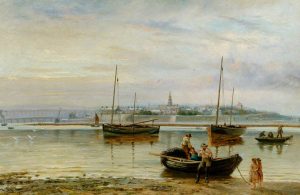
Unknown artist. 19th Century, painting oil on canvas, British (English) School.]
Author’s introduction: This painting, ‘View of Berwick-upon-Tweed from Spittal, Northumberland’, is held by Berwick-upon-Tweed’s Museum and Art Gallery. Little is known about it, neither the name of the artist nor the circumstances of its acquisition. Since many questions cannot be answered it could be considered a problematic item and, as a result, may spend proportionately more time safely stored and hidden from view in the museum. In this essay, I aim to momentarily lift this painting from the depths of anonymity by allowing it to speak to us—so we may see it afresh. And by engaging with the artwork in a ‘conversational style’ I’m using a creative writing technique known as ekphrasis.
I find myself blessed with three hours of leisure this Saturday forenoon. What finer occupation than to unfold my stool and settle myself amongst the rocks with my sketchbook?
Last week I saw Douggie here on the foreshore taking his ease with a pipe, the smoke drifting towards me on a light northerly breeze. I could not help but capture the scene with my pencil, the bold shape of the fishing cobble contrasted most agreeably with the man’s muscular form.
While I sketched he chatted with his two nieces—I know them as Isabel and Margaret—they are often to be found examining rock pools, skipping along the water’s edge, bringing vittles to their uncle and his company of fisher folk.
There is less activity here today. Indeed I am quite alone save for the gulls and a few skiffs out on the river. Though it is never quiet. For not far along in Sandstell Road, the herring workers at Boston Brothers’ yard are busy gutting fish—the women sing at all hours.
Sea water moves between the rocks sculpting indentations in the soft foreshore. I keep watch lest the water rises with the tide and soaks my shoe leather. On the breeze today come the layered odours of this place: bladders of seaweed stranded in the tidal mud mix with a strong metallic tang of blood, and the raw oily stench of fish-rich brine penetrates the fabric of everything—all the buildings hereabouts, and the boats, even the wool and cotton fibres of our clothing. Not that I would have it otherwise; I am glad for it; this honest steady work keeps families housed and fed.
A passenger train steams across the viaduct, loosing off a whistle as it slows on approach to the railway station. I follow its path high across the Tweed and my eyes settle on Berwick. I resolve to sketch the town as it spreads out before me.
Upon sliding open the lid of my wooden pencil box I notice some of the leads of the half dozen pencils I carry with me require attention. As the blade of my pocket knife slides rhythmically along their cedar casings my thoughts begin to turn on the final composition. I could situate Douggie and the girls in the foreground, the Tweed in the middle distance, and Berwick, within its walls, in the background. And, of course, the viaduct must be included; an admirable construction designed by Robert Stephenson. I was but a boy when it was built, and counted each of its twenty-eight arches again and again. My memory of the late Queen Victoria, though, is vague—Mother said the festivities for the official opening in 1850 of the Royal Border Bridge, as the viaduct became known, were most grand. It was a very great occasion.
Lifting the cover of my Winsor & Newton saddle-stitched sketch book and turning to a fresh clean sheet of cartridge paper—an ordinary action with a powerful effect—I get les frissons as the French would say.Then, with little hesitation, I make some light marks. Lines across the page; where foreshore meets water, where water meets land, and curves where the gentle mounds of terrain are visible behind Berwick. In my mind I divide the page vertically into three; the viaduct and Berwick Bridge will take the first third; the town will take the rest. Now I will concentrate on details. I have sketched this scene many times—the town walls act as a container for the buildings with their turrets and look-out points. Finally, I block in an outline of Douggie’s boat, positioned low on the paper to the right—this will serve as a natural focal point.
I enjoy sketching en plein air but prefer to paint in the quiet space I have set aside at the back of my house. Peggy, my wife, leaves me to work all day if I am so inclined. Unbeknown to her occasionally sit in the armchair with a glass of Madeira and become absorbed in thought, comforted by memories of the companionship of other painters who have visited me here in Spittal. Johnnie and David have both been to Carr Rock with me. We have had some very interesting discussions about the art world here while looking across to Berwick, and through them I keep in touch with happenings in Edinburgh and London. However, unlike them, I have little wish to make a name for myself. Instead I prefer privacy and the leisure to paint what I like when it suits me. And Peggy is content with this life.
Although, I must say, it is a privilege to provide guidance to some of the young people who visit—the school master sends them to me if they have an interest in the arts. I have high hopes for young Bill Paterson who has spent many an evening in my studio, drawing and painting—he has been asking his mother if she will set aside some space in the house for his own studio, and she has been asking me if he has any talent. Talent I say, goodness me, this boy has more than enough for all of Berwickshire!
I look up to the billowing clouds, then look down to the Town Hall. The architect knew his business, for when standing at its base, beside the four massive Tuscan columns, there is a feeling of awe. Today, as I look from Carr Rock, the 153 foot spire points like a dagger into the sky.
A freshening wind is getting up, making my fingers cold. I take in a draught of the salt-laden air, deep into my lungs, and I cough, and use my handkerchief. The light will not hold for much longer—the colours are extraordinary, salmon pink and lilac hues. I hastily make a note of this in the corner of my sketch book, as an aide-memoire. I am not yet ready to relinquish my stool but I must, my pocket watch informs me that Peggy will have the kettle on. I shall walk slowly back along the foreshore and, tomorrow, if the light is kind, I shall begin the painting.
Author’s Notes:
• Image credit: ‘View of Berwick-upon-Tweed from Spittal, Northumberland’ is from the ART UK website with credit to Berwick Museum & Art Gallery. (H 50.8 x W 76.4 cm). To fully appreciate this painting I visited the Museum stores to see it; access was facilitated by Dr Nathan Hood at The Living Barracks.
• My research suggests that this painting was made a little later than the current database suggests. I would place it in the early 20th Century rather than the 19th Century because we can identify a boat by its sail number, BK 77, and records show it was registered in 1901: named “Our Girls III”, weight 33 tons, J Dougal & Son, Eyemouth. An engine was fitted in 1912, and since this isn’t evident, I assume the painting to have been created some time between 1901 and 1912.
• I decided to situate our unknown artist at Carr Rock in 1905 as a 65-year-old man—fifty-five years after the Royal Border Bridge was opened (he would have been a ten-year old boy then).
• In my essay ‘Johnnie’ refers to John Blair (c.1849 -13 October 1934). He would have been 56 years old in 1905. A similar scene was painted by him c.1907— ‘Berwick from Spittal’. Blair was from Berwickshire, he then moved to Edinburgh to study and remained there for the rest of his life. As a contemporary, it is likely he knew our unknown artist.• ‘David’ refers to the Scottish artist David Young Cameron (1865 -1945). He would have been 40 years old in 1905. He sketched this scene, Berwick-on-Tweed, in 1906. It is likely he also knew our unknown artist.
• ‘Bill Paterson’ refers to W J Patterson. From his paintings we know he was active between 1925 and 1952 but we don’t know his dates or his full name. A painting titled ‘Flowing Tide’, dated 1925, depicts a similar scene. I imagined, for the purposes of this essay, that ‘W’ stood for William, hence I refer to him as Bill; and, if an adult in 1925, I can assume he would have been a boy in 1905.

On the Edge
Peter Bromley
Peter Bromley started to write short-fiction a number of years ago before turning to longer fiction. His novels Of Human Folly and The Tale of the Strayaway Child, as well as a new collection of short fiction, Skylight, have been published through Silver Quill, an independent, writer-led publisher.
He lives with his family in North Northumberland where he writes, walks the coast and plays the fiddle. He is a member of the Society of Authors and has spoken at a number of literary and book festivals.
Of this piece, Peter tells us, 'The work was inspired by the coastal landscape of Scotland, the stories that came from the records of St Kilda and the unfolding tragedy of the images on the TV at the time. I looked for a way to bring them all together.'
@petebromwrites
On the Edge
The man on the television was crying.
His lined face, large and tanned, was set against a background of pale mountains. His turban was coming loose. The camera panned back to show him holding the body of a child as he explained that his own countrymen had been attacking his village with gas. His eyes flicked like those of a trapped animal between the camera and the interviewer. He wanted someone to help him understand.
I watched the footage of dead mothers and fathers lying over the bodies of their children, having tried vainly and naïvely to protect them from the invisible cloud. Then, when the camera cut back to the man, he started to cry. He moaned and then rocked backwards and forwards with grief as he explained that he had been at market in a distant town, so missing the attack. He said that he wished he was also dead then stared silently at the camera, waiting.
They called me on the radio, so I turned off the television. They told me a storm was coming and that they were concerned for me. I said I knew about the storm. I had seen the weather forecasts that they regularly emailed to me so of course I knew about the storm. I was my job to know about the storm.
“We are worried about you.”
“I’m OK,” I said.
“But you’re on your own.”
“I volunteered to be here.”
“That’s not the point.”
“I’ll survive.”
“I’m sure you will.”
I turned to watch the gannets through the window next to the desk in my office. They are large awkward birds on land, but once they are in the water, they are powerful and so perfectly shaped. Pure white knives cutting silently into the ocean. They rarely come ashore, except for breeding when they use rocky outcrops like this one. From the lighthouse I could see them both on the rock and also far out to sea where they flew in search of food.
“I’ll survive,” I said again.
The man was on television again. Each news broadcast carried his picture and that of the dead villagers. The scenes were becoming padded out with maps and long distant shots of the surrounding mountains, but at the core of the broadcast, the man and his son remained. The man looked old, but was probably no older than me. Some of his teeth were missing in the front of his mouth and he had a deeply wrinkled face. He had a cut above one eye, but the roughness of the scab did not look too different from the rest of his skin. He stared intently at the camera as tears ran down his cheeks; only when the camera panned down to take a shot of the son did his head move to look at the small limp bundle in his arms. The son was lying flopped across his father’s arms. One of the boy’s legs dangled free, a rough dusty sandal on his foot. The boy’s red and green shirt and loose red cotton trousers flapped gently in the air. The man blinked against the sun. He ended in silence, staring at the interviewer before turning to walk away from the camera, back into the house behind him.
Between writing my reports in the silence of my glass world and the television, I watched the birds, distant through my small round windows. I kept my binoculars by my side. Occasionally I picked them up to follow the individual birds that were many kilometres out to sea. I watched the silent white splashes appear on the surface of the sea as each bird dived into the gentle swell. They were more active than ever; the young birds were growing up and getting ready to leave. There is usually a lot of activity in the colony, but the movement was becoming intense. The large birds flew to find ever increasing amounts of food for their young. The adult birds spent all day out at sea; diving, flying, diving, flying. Then one day they would be gone.... North Africa, The Bay of Biscay, Iceland....places I had only ever seen on maps.
On the rock, the gannets and kittiwakes began to settle down to sit out the storm. There was less flying out to sea. Instead, they sat quietly and began to await the inevitable. They squeezed into small cracks and crevices to afford themselves a little protection. The adults still tried to give their young some warmth by wrapping their wings around them.
A few days ago, I saw a Roseate Tern. It just stopped for a rest then it was gone. God alone knows how far it had flown or where it was going. This island is not on its usual migratory route. My book described it as a very rare visitor to these coastal areas. So what drove a thing so small and so delicate to this rock? What lay in its sharp skull and behind its pin-bright eyes? It was sitting on the rail around the upper light and I simply moved across the window and it was gone. Presumably it had been knocked off course by the storm. But as the clouds gathered on the distant horizon it headed back towards them and the advancing veils and curtains of rain. I watched it through my window.
At school I used to listen only occasionally to Mr Mc Dermott, the teacher, when he told us about birds and wildlife. I would walk to school along the rough road and pay more attention to my games than the wildlife around me. Once Megan Leary pointed to a bird that was singing as it ascended in a series of bursts.
“There’s a skylark,” she said.
“Here’s a right lark,” I said pushing her.
Megan married Declan and moved away from the area before I did. In my class at school, Mr McDermott had much better stories to tell. He told us about the Island of St. Kilda. He showed us a map of Scotland and pointed to somewhere out in the middle of the Atlantic or so it seemed to me. Then he told us about the people who used to live there: Simple and God-fearing he called them. I loved that phrase.
He told us how they were removed from their homes and how the island became a military base. He told us how the islanders used to send and receive mail in a wooden box attached to an inflated sheep’s bladder. The young men of St. Kilda would climb cliffs in their bare feet to get gull and kittiwake eggs for food. Before they were allowed to do this, they had to show their bravery by standing at the edge of a towering granite ledge in bare feet. Then they had to stand with only their heels on the rock, and finally they were to stand with only one heel on the rock with 30 their other leg and their foot wavering out over the distant sea. Mr McDermott showed us photographs of the people of St. Kilda. They were small, almost fat people; perhaps they looked that way because of all the thick clothing they had to wear. Their beards were rough and unkempt. “Simple and God fearing.”
On the way home from school, Megan and her brother, James and I played at being on St. Kilda. James took off his shoes and tried to balance on one of his father’s farm walls. At first he could not manage to balance on the rough granite blocks of the wall, but eventually he edged his toes out over the fresh air. With time, as the dusk drew in around us, he managed to balance on one heel, his foot half on and half off the wall. I could not do it and neither could Megan who was younger than us both. I satisfied myself by thinking that James would not have been able to balance on the rocks had they been a hundred metres high and not just one metre. As we walked to our respective homes, in the gloom I heard James shout, “King of St. Kilda.”
The man appeared on the television again. The images hardly varied. Occasionally the order changed, but always the same message came across; he was at market so he missed the gas attack but all his family was killed, including his three year old son. He wished he was also dead. Some images, like these come to represent entire episodes of life, like the picture of the young naked girl running away from the bombing in the Vietnam war. Or the loyalist soldier being shot during the Spanish Civil War, his arms outstretched as if he was being crucified. Sometimes we live through important times.
There was world-wide reaction to the gassing. In a far away building, the Ambassador of the man’s country at the United Nations denied the gas attack and blamed the deaths on The Hand of God. He was surrounded by television cameras, microphones and jostling angry people. Outside the UN building a crowd of people was waving banners and placards.
The man’s role was reduced to a small cameo; we saw his tears and his dead child, but as we heard the voices of the newsreaders we saw other dead mothers and fathers and their children. They must have fallen just where they were when the gas hit them and only a few parents had a chance to cover their children. Some groups of bodies lay next to games or books spread out on the dirt road outside the houses. Others were in the corners of courtyards around unfinished meals. The people from outlying villages arrived to bury their relatives and friends. Those that had not been buried were covered with blankets. And still the man came onto each broadcast crying and wishing he were dead.
I ventured out onto the rock.
I had been busy but I tried to get out at least once each day. Walking carefully amongst the birds so as not to disturb them, I passed through a slowly moving lawn of white; like a silk sheet rippling. The birds barely acknowledged my presence, but simply ruffled their feathers and fidgeted on their rough nesting mounds. I walked the hundred or so metres to the end of the rock and looked out over the to the west. Above the line of the horizon, I saw the first few clouds that formed the leading edge of the storm. There, just beyond my view, was the storm that knocked the tern off course as it tried to find its directions in the maelstrom. In the evening glow I tried to bring myself to stand on the edge of the rock, with my toes out over the ocean. Below me was a ten metre drop into the water. I didn’t do it. Instead, I turned and walked back amongst the birds.
When I returned to the lighthouse the radio was crackling.
“Where have you been?” asked the voice when I picked up the receiver.
“Nowhere.”
“We’ve been trying for ten minutes.”
“Sorry.”
“Shall we come and get you.”
“No. I’m fine.”
The next morning, I walked to the top of the lighthouse to watch the clouds gathering. Then I went through my routine and checked the systems. The radio receiver I was upgrading was to be controlled by a single computer; one station would handle over fifteen lights along this coast. I just needed to be present as it was re-tested for the first time.
As the first specks of rain began to fall I went down the steps and out onto the rock. The wind was growing. The birds were adjusting themselves to meet the storm head on. The younger birds were being protected by their parents whilst the older chicks settled down alongside the adults. I was about half-way along the rock when, almost without notice, the wind and rain hit the rock hard. I turned around to return to the light, but before I closed the door into the storm I looked back over the colony to see the birds squatting and crouching close to the rock.
Back in my office, I watched them through the window.
Mr. McDermott told us of the storms on St. Kilda. Of how the boats could not put to sea for weeks, sometimes months. The whole Atlantic Ocean would seem to hurl itself at the 33 small granite island and the islanders could only sit and wait.
He read us accounts of the storms, of the islands and how whole herds of sheep were moved from island to island to graze the scarce grass. During storms the sheep could die of starvation if left for too long on small islands where there was too little food. Or they would be washed off the islands by the large waves and their bodies would float, rotting and bloated, between the islands. The storms, he said, were the reasons that the authorities gave for the removal of people from the islands. But, Mr. Mc Dermott said that it was really because they wanted the island for a military base. So Mr. McDermott’s grand-parents were shipped off the island and were given a home in Glasgow. He had a photograph of the tall tenement block in which his ancestors lived and, only five months after arriving off St. Kilda, died.
“They couldn’t take it, you see,” he said as we stared at the crumpled photo. “ And I end up teaching you lot,” he would always say, smiling again.
At the end of each term, as a special treat, he would tell us stories of St. Kilda.
Through the storm the television images moved on. They still showed the man, but also the remaining villagers from surrounding areas packing up their belongings and moving down the hillside into the rocky valley floor. They said that they were moving together for safety. They sat in family groups in the bare countryside. Tents were being flown in from around the world and they clung, with their occupants, to the rocks and scree. Simple and God-fearing people. Occasionally the sound disappeared from the television, so the man’s voice came and went. The storm raged outside my room, silencing the man’s sorrow. The hills where the people gathered were bare and dusty and the sun cast deep shadows in the valleys. The people sat motionless outside their tents on the pale stones as the camera panned across their faces. The reporter then stood facing the camera to tell us that the refugees would need to be moved to safer and more suitable ground far away from their homes as the mountains could not sustain them for very long. He told us that the valleys were inaccessible for the rescue services and international aid.
And, finally, the man appeared again, holding the body of his young son.
As the storm subsided after many hours, I once again looked out onto the rock below. The groups of birds were bedraggled and weather-beaten; lying and crouching together with the young moving as close to their parents as possible. I watched both the television and the storm until the rain and wind finally abated. When it did so, I went down the steps and onto the shining rock once more. Many of the birds were badly injured, and a lot were dead. Others were just in shock. But already they were starting to get on with their lives. Some were flying off to sea again to seek the food for their young.
At the end of the rock, I stared down into the muddied waters. The storm had stirred up sand and seaweed and clouded the normally clear sea. It moved aggressively some distance below me. I sat on the edge with my feet dangling into space beneath me. I moved my legs from side to side to the rhythm of the waves, tapping my heels against the rock.
After several minutes I stood up and took off my shoes. I moved slowly towards the edge of the cliff. For a short time I waited about a metre back from the drop but then I shuffled, a few centimetres, at a time, until my toes were at the absolute edge of the rock. Then I manoeuvred my feet timidly until the toes were over the edge. I moved on until half of each foot was sticking out over the rock; I rested only on my heels. Then I lifted one foot and stretched it out in front of me. I stood with only one heel on the rock with the rest of me suspended in space over the sea.
I looked towards the horizon from which the storm came and towards which the tern flew. I looked from side to side at the confusion and sorrow around me in the colony until my calf-muscles ached. Then, I slowly stepped back from the edge. I put my shoes and socks on and returned to the lighthouse. The birds were quite still and subdued as I moved amongst them.
Back in the lighthouse I answered the radio.
“We’re coming to get you.”
“I’m alright.”
“We’re coming to get you. How are things ?”
“Nothing changes.”
“We’ll send a boat.”
“I’m not going anywhere,” I said.
So now, for the last time, I sit at my desk and through the small window I see the birds. More of them are venturing out to sea again. I pick up my binoculars and follow them. I look down also at the birds still sitting on their nest sites. I look at those that are injured and at those that have been killed by the storm. Their bodies lie in strange, contorted shapes, their necks badly twisted. I think to myself, “The Hand of God.”
From time to time I turn my binoculars towards the headland.
After about half an hour a small boat emerges from behind it. Beyond it, and oddly out of proportion because of the binoculars, rises the cliff; thirty, forty, fifty metres in a vertical climb. I imagine myself standing barefoot at the top of that cliff; The King of St. Kilda.
The boat moves slowly through the open water. It will take an hour and a half, possibly two, to reach me. It moves carefully through the swell which is still high after the winds.
Once it is clear of the cliffs, it turns towards the lighthouse, towards the island and the calm which is all that remains of the storm.